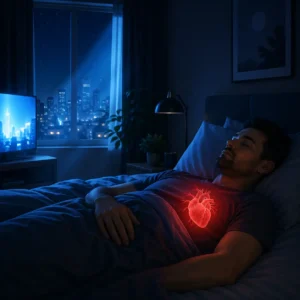
Do you sleep with a TV on? Or maybe your bedroom window lets in the glow of streetlights?
Most people think “light at night” is just a sleep problem. But according to a massive new study published in JAMA Network Open, it’s actually a heart problem (Windred DP, et.al., 2025).
Here is the data-backed truth about how light exposure is impacting your cardiovascular health—and what you can do about it today.
The Massive Study You Can’t Ignore
Researchers looked at nearly 89,000 people over a 9.5-year period. They didn’t just ask people how much light they saw; they had them wear light sensors to track 13 million hours of exposure.
The results were shocking.
When they compared people who slept in the darkest environments to those in the brightest, the “bright light” group had a much higher risk of major heart issues:
- Heart Failure: 56% higher risk
- Heart Attack (Myocardial Infarction): 47% higher risk
- Coronary Artery Disease: 32% higher risk
- Stroke: 28% higher risk
Why Does This Happen?
The Circadian Connection
Your body runs on a “circadian rhythm”—an internal clock that tells every cell in your body when to work and when to rest.
When you expose yourself to light at night, you confuse that clock. This “circadian disruption” leads to inflammation, higher blood pressure, and metabolic changes.
Think of it like this: your heart is trying to recover from the day, but the light is telling it to stay on high alert. Over time, that stress adds up.
Who Is Most at Risk?
The study found that while everyone is affected, two groups saw even higher risks:
1. Females: Showed a stronger link between night light and heart failure.
2. Younger Adults: Interestingly, younger individuals in the study, those closer to 40, saw a higher risk for atrial fibrillation than the older participants.
Support Your Health with Pure Encapsulations
In addition to improving your sleep environment, targeted supplementation can be a helpful way to support your overall wellness routine.
I recommend Pure Encapsulations supplements because they are high-quality, professional-grade products designed to support health from the inside out.
Use this link to register with Pure Encapsulations and receive a 5% discount and free shipping on all orders.
3 Simple Steps to Protect Your Heart Tonight
You don’t need a medical degree to fix this. You just need to control your environment. Here is my “Dark Room Checklist”:
- Invest in Blackout Curtains: Streetlights are a major culprit. Block them out completely.
- Ditch the Night Light: If you need a light for safety, use a dim, red-toned bulb. Red light is much less disruptive to your internal clock than blue or white light.
- The “Device-Free” Hour: Turn off the TV and put the phone away 60 minutes before bed. If you must use them, use “Night Mode” to reduce blue light.
The Bottom Line
We spend a lot of time worrying about diet and exercise. And while those are vital, your environment matters just as much.
The science is clear: Darker nights mean a healthier heart.
Are you going to make your bedroom darker tonight? It might be the easiest health hack you ever try.
Reference
Windred DP, Burns AC, Rutter MK, Lane JM, Saxena R, Scheer FAJL, Cain SW, Phillips AJK. Light Exposure at Night and Cardiovascular Disease Incidence. JAMA Netw Open. 2025 Oct 1;8(10):e2539031. doi: 10.1001/jamanetworkopen.2025.39031. PMID: 41129148; PMCID: PMC12550636.