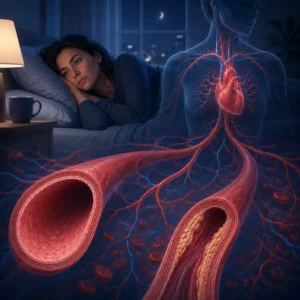
We all know that skipping sleep makes us feel tired and grumpy, but a study published in the Journal of the American Heart Association (Calvin AD, et.al., 2014) shows it does something hidden and potentially dangerous to our bodies: it damages the inner lining of our blood vessels.
The Mystery of Sleep and Heart Health
For years, scientists have noticed that people who regularly get less than 7 hours of sleep have a higher risk of heart attacks and strokes. However, they didn’t fully understand why.
To investigate, researchers looked at the endothelium. This is the thin, delicate lining inside your blood vessels. A healthy endothelium acts like a flexible, slippery highway that allows blood to flow smoothly. When it gets damaged or stiff, a condition called endothelial dysfunction, it becomes one of the very first warning signs of heart disease.
How the Study Worked
Researchers brought 16 healthy volunteers into a hospital research lab. They split them into two groups for 8 days and nights:
- The Control Group: Slept normally, averaging about 6.9 hours a night.
- The Sleep-Restricted Group: Had their sleep cut by one-third, leaving them with just 5.1 hours a night.
To see how well their blood vessels were working, scientists used a test called Flow-Mediated Dilation (FMD).
As shown in the diagram, doctors temporarily restrict blood flow in the arm with a blood pressure cuff and then release it. In a healthy person, the blood vessels should rapidly widen (dilate) to handle the rush of returning blood.
The Results: A Hard Hit to Blood Vessels
The results were stark. The group that slept just 5 hours a night saw their blood vessels lose a massive amount of their natural flexibility.
| Group | Before the Study | After 8 Days | What Happened? |
|---|---|---|---|
| Normal Sleep (~7 hours) | 5.0% dilation | 6.7% dilation | Blood vessels stayed healthy and flexible. |
| Restricted Sleep (~5 hours) | 8.6% dilation | 5.2% dilation | Significant drop in flexibility. |
The blood vessels of the sleep-deprived group simply couldn’t open up normally when the body needed them to. Meanwhile, the group getting normal sleep experienced no negative changes.
The Takeaway: It only took 8 days of getting 5 hours of sleep to cause measurable, physical damage to the cardiovascular system of perfectly healthy humans.
Support Your Health With Pure Encapsulations
Pure Encapsulations offers high-quality supplements designed to support your health and wellness.
Register with Pure Encapsulations to receive a 5% discount and free shipping on all orders
What This Means For You
The scary part of this study is that 5 hours of sleep isn’t an extreme scenario. Millions of people routinely sleep 5 hours a night due to work, stress, or late-night scrolling.
The good news? The study suggests this damage is directly tied to your sleep habits. Protecting your sleep schedule isn’t just about curing brain fog; it’s a vital way to keep your blood vessels flexible and protect your heart.
Reference
Calvin AD, Covassin N, Kremers WK, Adachi T, Macedo P, Albuquerque FN, Bukartyk J, Davison DE, Levine JA, Singh P, Wang S, Somers VK. Experimental sleep restriction causes endothelial dysfunction in healthy humans. J Am Heart Assoc. 2014 Nov 25;3(6):e001143. doi: 10.1161/JAHA.114.001143. PMID: 25424573; PMCID: PMC4338700.