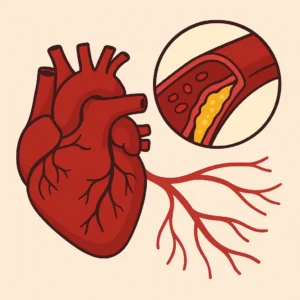
 If you’ve ever had your cholesterol checked, you’ve probably been told to keep your LDL (“bad” cholesterol) under 100–115 mg/dL. Sounds reasonable, right?
Well… a landmark paper in the Journal of the American College of Cardiology says otherwise (O’Keefe JH Jr, et.al., 2004).
And the real answer might surprise you.
Your Body’s “Factory Settings” Are Much Lower
The researchers point out something fascinating:
- Hunter-gatherers (no statins, no processed food, no desk jobs)
- Healthy newborn babies
- Wild primates
- Pretty much every mammal that doesn’t get heart disease
All run LDL levels between 50 and 70 mg/dL—naturally.
So the “normal” range most doctors quote today isn’t actually what humans evolved with. It’s just what’s common in modern society… a society that has a lot of heart disease.
Lower LDL = Less Plaque, Fewer Heart Attacks
The authors looked at randomized clinical trials where LDL was aggressively lowered.
Here’s the money line:
When LDL drops below 70 mg/dL, the progression of atherosclerosis slows way down—and heart attack risk goes down with it.
And when treated patients hit the 50–70 mg/dL zone?
That’s where the biggest protection kicks in.
But Is It Safe to Go That Low?
This is the part everyone worries about.
According to the study:
Yes.
Across trials where LDL was brought down to the 50–70 range, no major safety issues showed up. This level appears to be not only safe but also physiologically normal—exactly where humans sat before modern diets disrupted the picture.
Pure Encapsulations Supplements
Pure Encapsulations offers high-quality, professional-grade supplements that can support your overall health.
Register with Pure Encapsulations to receive a 5% discount and free shipping on all orders.
So Why Do Guidelines Still Recommend 100–115?
In short: guidelines lag behind evidence.
The authors argue that using 100–115 mg/dL as the treatment goal undertreats high-risk patients, leaving many people exposed to preventable heart disease.
The Bottom Line
If you’re thinking about heart health, here’s the takeaway:
- 50–70 mg/dL is the true optimal LDL range.
- Humans evolved with it.
- People who have it don’t get atherosclerosis.
- Clinical trials show fewer events at this level.
- Safety concerns? None found.
Lower isn’t just “okay.”
Lower is better—and natural.
Reference
O’Keefe JH Jr, Cordain L, Harris WH, Moe RM, Vogel R. Optimal low-density lipoprotein is 50 to 70 mg/dl: lower is better and physiologically normal. J Am Coll Cardiol. 2004 Jun 2;43(11):2142-6. doi: 10.1016/j.jacc.2004.03.046. PMID: 15172426.