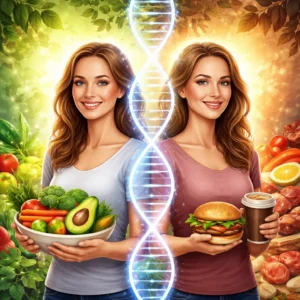
We’ve all heard that eating more plants is good for you — but what if it could also turn back your biological clock? A recent study from Stanford University and collaborators called the Twins Nutrition Study (TwiNS) has uncovered exciting evidence that going vegan might actually help you age more slowly — right down to your DNA.
The Study: Identical Twins, Two Diets
To really understand how diet affects aging, researchers recruited identical twins — because twins share the same genes, any differences that show up can be linked to lifestyle rather than genetics (Dwaraka VB, et.al., 2024).
For 8 weeks, one twin followed a fully plant-based (vegan) diet, while the other ate a healthy omnivorous diet (including lean meats, dairy, etc.). Researchers looked closely at changes in their DNA methylation patterns — chemical tags that act like switches, turning genes “on” or “off.”
These patterns are powerful indicators of biological age, meaning how old your body acts, not just how many birthdays you’ve had.
What They Found: Vegan Twins Aged More Slowly
The results were pretty fascinating:
- The vegan twins showed reduced “epigenetic age acceleration” — a science-y way of saying their biological aging appeared to slow down.
- There were distinct, diet-specific changes in DNA methylation markers tied to inflammation, metabolic health, liver function, and heart health.
- The vegan twins also consumed fewer calories without trying, which may have contributed to the anti-aging impact.
Why This Matters
Epigenetics is one of the hottest areas in aging research. Unlike your genes, your epigenetic patterns can change based on your environment, lifestyle, and food choices. This means what you eat today really can influence how young (or old) your body feels tomorrow.
The TwiNS results add to a growing body of evidence that plant-based diets may slow biological aging, reduce inflammation, and boost overall metabolic health.
Supporting Your Nutrition with High-Quality Supplements
Whether you follow a vegan, plant-forward, or omnivorous diet, nutrient quality and absorption matter — especially for long-term health and healthy aging.
Pure Encapsulations offers professional-grade supplements made with high-quality ingredients and rigorous manufacturing standards. These supplements can help support optimal nutrition, fill dietary gaps, and complement a longevity-focused lifestyle.
You can register through my practice to receive 5% off and free shipping on all orders.
The Big Picture: It’s About Personalization
While the study is small and lasted only two months, its implications are big. It also used epigenetic biomarker proxies — meaning scientists can now measure the impact of diet on aging more precisely than ever.
The takeaway? A vegan diet — or at least a plant-forward one — might be a powerful tool in your longevity toolkit. But balance and proper nutrient intake still matter. Future research will explore how long-term plant-based eating affects health and performance.
Bottom Line
A short-term vegan diet showed measurable signs of slowing biological aging at the DNA level.
If you’ve been on the fence about eating more plants, this might just be the nudge you needed — younger cells might thank you for it.
Reference
Dwaraka VB, Aronica L, Carreras-Gallo N, Robinson JL, Hennings T, Carter MM, Corley MJ, Lin A, Turner L, Smith R, Mendez TL, Went H, Ebel ER, Sonnenburg ED, Sonnenburg JL, Gardner CD. Unveiling the epigenetic impact of vegan vs. omnivorous diets on aging: insights from the Twins Nutrition Study (TwiNS). BMC Med. 2024 Jul 29;22(1):301. doi: 10.1186/s12916-024-03513-w. PMID: 39069614; PMCID: PMC11285457.