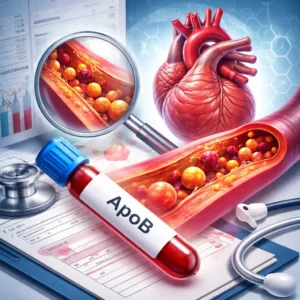
 When it comes to heart health, most people know about “good cholesterol” (HDL) and “bad cholesterol” (LDL). For years, doctors have measured LDL cholesterol to assess cardiovascular risk. But what if we’ve been looking at the wrong marker all along?
A 2019 review published in JAMA Cardiology suggests exactly that — Apolipoprotein B (ApoB) might be a better way to measure your heart disease risk than traditional cholesterol tests (Sniderman AD, et.al., 2019).
The Big Idea: It’s About the Number of Particles — Not Just the Cholesterol Inside
Here’s the key insight:
Cholesterol gets carried around your body inside particles known as lipoproteins — think LDL, VLDL, and others. Each lipoprotein particle contains one ApoB molecule. That means ApoB gives you a direct count of how many potentially harmful particles are in your blood.
Why does this matter? Because the amount of cholesterol inside those particles can vary. Some ApoB particles carry lots of cholesterol, while others carry very little. But each one has the same chance of getting trapped in your arteries — and that’s what leads to plaque buildup and heart disease.
Why ApoB Is More Accurate
The study’s authors explain that smaller, cholesterol-depleted ApoB particles are actually stickier. They bind more tightly to your artery walls and are more likely to get stuck — even though they carry less cholesterol per particle.
This means that the number of ApoB particles (not their cholesterol content) is what really drives atherosclerosis. Measuring ApoB gives a clearer picture of your risk than either LDL cholesterol or non-HDL cholesterol levels.
What This Means for You
If you’re serious about preventing heart disease, talk to your doctor about getting an ApoB test. It’s not yet part of every standard blood panel, but that might change soon. ApoB testing can help catch elevated cardiovascular risk even when your LDL levels look “normal.”
Supporting Your Heart Health with High-Quality Supplements
In addition to lab testing and lifestyle changes, targeted nutritional support can play an important role in cardiovascular health.
Pure Encapsulations offers pharmaceutical-grade supplements that are rigorously tested for purity, potency, and quality — making them a trusted choice.
You can register through this link to receive 5% off and free shipping on all orders.
The Bottom Line
According to the JAMA Cardiology review, Apolipoprotein B simplifies and strengthens how we measure atherogenic (artery-clogging) risk.
In short:
- Cholesterol doesn’t cause heart disease — ApoB particles do.
- Fewer ApoB particles = lower risk of heart attack or stroke.
If cholesterol numbers have you confused, focusing on ApoB could be the simple metric that finally makes sense.
Reference
Sniderman AD, Thanassoulis G, Glavinovic T, Navar AM, Pencina M, Catapano A, Ference BA. Apolipoprotein B Particles and Cardiovascular Disease: A Narrative Review. JAMA Cardiol. 2019 Dec 1;4(12):1287-1295. doi: 10.1001/jamacardio.2019.3780. PMID: 31642874; PMCID: PMC7369156.